
The New CRO’s First 100 Days: A Strategic Guide
“Department of No” to Strategic Enabler.

Highlights
This article outlines a strategic 100-day framework for new Chief Risk Officers to transition from reactive compliance to proactive business enablement.
Discover how to secure "quick wins" that demonstrate immediate ROI to the C-Suite.
Learn strategies to audit legacy tools and modernize your tech stack with AI.
Master the cultural shift from being the "Department of No" to a strategic pilot.
The First 100 Days: A Strategic Manifesto for the Modern Chief Risk Officer in 2026
The ink is barely dry on your contract. You have just stepped into the role of Chief Risk Officer (CRO) or Head of Risk at a new enterprise. The welcome emails are flooding in, the calendar invites are stacking up, and the pressure is already mounting. You are not just stepping into a new office. You are stepping into a minefield of expectation.
In 2026, the mandate for a risk leader has fundamentally shifted. You are no longer hired simply to be the "corporate brake," charged with halting dangerous activities or ticking compliance boxes. The modern enterprise, operating in a volatile economy defined by rapid technological disruption and geopolitical fragmentation, requires something different. It requires a strategic enabler. It requires an architect of resilience who empowers the organization to take calculated risks with precision and confidence.
For the incoming CRO, the challenge is acute. You are likely walking into an organization paralyzed by a binary view of risk. They see it as a choice between reckless speed or stifling caution. The legacy of the "Department of No" looms large. This creates cultural friction where business units hide their activities from you, particularly in the realms of digital innovation and shadow IT, just to avoid bureaucratic obstruction.
You have roughly 90 to 100 days to change this narrative. You need to prove that risk management is not a cost center but a competitive advantage. This article provides a tactical roadmap for your first three months. We will explore how to transition from an observer to an operator, utilizing the advanced concepts found in the Unified Intelligence Platform by Risk Llama to turn uncertainty into value.
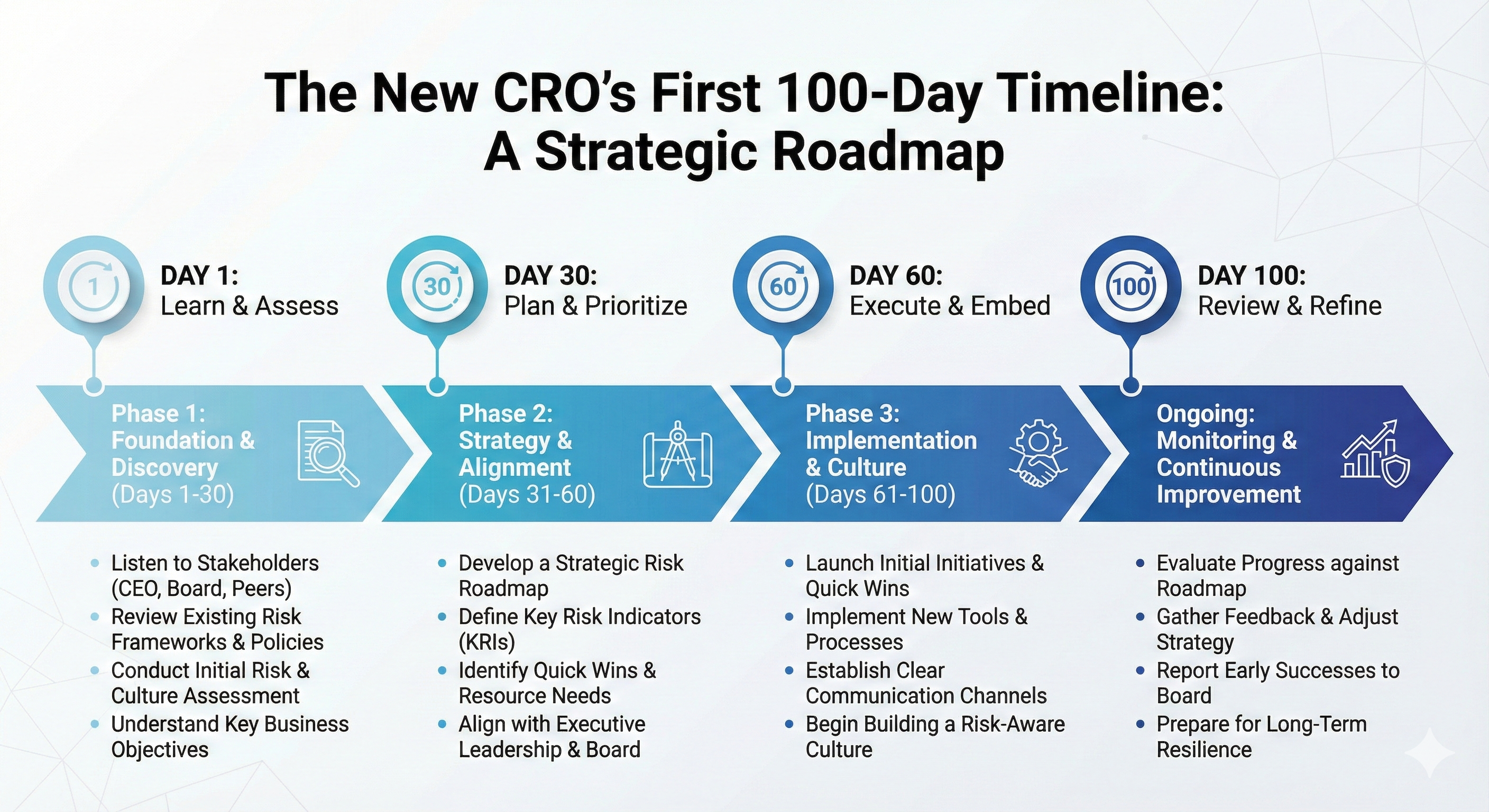
Phase 1: The Diagnostic Anthropologist (Days 1–30)
Your first month must be defined by aggressive listening and forensic observation. Industry veterans often liken this period to that of an anthropologist entering a new society. Your goal is to understand the unwritten rules that govern behavior just as much as the codified policies. You must resist the urge to implement immediate changes, as premature action can trigger an organizational immune response. Instead, focus on mapping the true flow of power, data, and risk within the enterprise.
The "Listening Tour" Strategy
A robust stakeholder engagement plan is the foundation of your diagnostic phase. While alignment with the CEO and CFO regarding budget and strategic vision is a prerequisite, the true insights regarding the organization's risk culture reside closer to the operational edge.
You need to conduct structured interviews with key functional leaders, specifically targeting those who have historically viewed risk management as an adversary. When you sit down with the Chief Revenue Officer, do not just ask about their targets. Ask them where the deal approval process stalls. Ask them what workarounds their team has developed to meet quotas. This is where you identify "shadow processes" and unauthorized contractual liabilities.
When you speak with the Chief Marketing Officer, ask which generative AI tools their creative teams are piloting to increase content velocity. This conversation often leads to the discovery of Shadow IT and potential IP leakage. These interactions are not just about building rapport. They are about finding the friction points where the "Department of No" legacy has forced innovation underground.
Uncovering the "Shadow Enterprise"
One of the most pervasive threats to modern enterprise security is Shadow IT. This involves the use of software, applications, and cloud services without the explicit approval or knowledge of the IT or risk departments. In large enterprises, this can account for 30 to 40 percent of total technology usage.
Simply asking employees what tools they use is rarely sufficient. Fear of retribution or confiscation often leads to underreporting. This is where you need to deploy a more sophisticated . By leveraging tools like Risk Llama’s survey tool, you can move beyond manual surveys.
You need to perform a "Shadow Discovery" protocol. This involves collaborating with finance to audit expense reports for low-cost SaaS subscriptions that bypass procurement thresholds. It involves working with security to review network traffic for high-volume data flows to non-sanctioned domains.
The danger of Shadow IT is not merely the cost of duplicative licenses. It is the fragmentation of the enterprise's data estate. When critical business logic or sensitive customer data resides in a personal workspace or a rogue cloud instance, it is invisible to your disaster recovery protocols and cybersecurity defenses. Our research found that disconnected apps and data silos drain time (12+ hours wasted a week) and money (2-5% EBITA), with 40% of critical risk data often trapped behind walls. Your first month is about tearing down those walls to see what lies behind them.
The Regulatory "Health Check"
The regulatory landscape is characterized by divergence and intensification. With the EU AI Act, stricter SEC cybersecurity disclosure rules, and various operational resilience mandates coming into force, you need to perform a rapid gap analysis.
This is not a full audit. It is a pulse check. Does the organization have an inventory of AI models? Does it know which models are "high risk" under new regulations? If the answer is no, you are already behind. Tools like our `` can automate the assessment of business identity and compliance, saving you hours of manual checking and providing instant verification that would otherwise take weeks.
Phase 2: Strategic Architecture & The "Quick Win" (Days 31–60)
Having diagnosed the friction points, you must now articulate a new strategy. The defining characteristic of the modern, growth-oriented CRO is the shift from a "No" culture to a "Yes, If" culture.
Redefining Risk Appetite: From "No" to "Yes, If"
The "Department of No" blocks innovation to ensure safety. The "Yes, If" department enables innovation by defining the safety parameters within which it can occur. This semantic shift signals a profound change in your operational philosophy.
Consider the adoption of Generative AI. A traditional risk response might be to ban public Large Language Models (LLMs) due to data privacy concerns. This inevitably leads to employees using the tools secretly on personal devices. A "Yes, if" response acknowledges the need for speed and efficiency. You might say, "Yes, you can use Generative AI for drafting, IF we implement data sanitization guardrails and use an enterprise license."
This approach transforms you from an adversary into a partner. It acknowledges the business need while effectively mitigating the specific risks.
The "Quick Wins" Strategy
New executives have a limited window to prove their value. The honeymoon period dissipates quickly. To secure political capital and budget for long-term transformation, you must deliver tangible wins in your second month.
Quick Win 1: Rationalizing Tool Sprawl
Most organizations have accumulated a disjointed stack of GRC tools, audit software, and dashboards that do not communicate with one another. This fragmentation is costly and inefficient. Our solution overview notes that manual assessments waste at least 12 hours a week per analyst.
You can conduct a tool audit to identify overlapping capabilities. By consolidating these disparate tools into a single platform , you can demonstrate immediate cost savings to the CFO. Risk Llama allows you to move from reactive "tick-box" compliance to proactive value creation, often saving significant budget against comparable point solutions.
Quick Win 2: The Shadow IT Amnesty
Using the inventory created in Phase 1, launch a "Shadow IT Amnesty" program. Invite employees to declare the unauthorized tools they are using without fear of punishment. In exchange, promise to vet these tools for security and procure them officially if they pass. This brings hundreds of unknown risks into the light immediately and positions your team as a service provider rather than a police force.
Quick Win 3: The Board Reporting Overhaul
Board members struggle with complex, color-coded heat maps that do not clearly convey business impact. Redesign your quarterly risk report to focus on financial materiality and strategic impact. Instead of listing "Cyber Risk" as "High," report that a specific vulnerability threatens a percentage of quarterly revenue.
Utilize Alignment maps from Risk Llama to visualize this. These maps connect risk impact directly to business outcomes, untangling complexity and showing the board exactly how risk management protects revenue goals. This speaks the language of the business and elevates the perceived strategic maturity of your function.
Constructing AI Governance Guardrails
As your organization accelerates AI adoption, you must erect the scaffolding of governance. This involves addressing the "Black Box" problem, where AI decision-making is opaque.
Implement a risk-based classification for all AI projects. Critical systems making decisions with legal or financial impact must use interpretable models. Operational systems assisting internal workflows require human-in-the-loop verification. By using Lluma AI , your personal AI Risk Manager, you can surface root-cause insights and seal control gaps instantly through natural language processing, ensuring you have "Single-Line-of-Sight Governance" over these complex systems.
Phase 3: Execution & The Move to Real-Time (Days 61–90+)
By the third month, you must shift from planning to operational execution. The traditional model of risk management, reliant on annual assessments and manual surveys, is obsolete. Threats move at the speed of fiber optics. Your goal is to move to Real-Time Risk Observability.
Operationalizing Risk Observability
You need a platform that does not just store data but actively monitors it. This requires the deployment of Always-On Intelligence . Unlike legacy GRC platforms that offer static reports, Risk Llama utilizes multi-agent AI architectures to analyze millions of data points 24/7.
This integration connects your risk function to the heartbeat of the enterprise. The system should trigger an alert the moment a risk indicator breaches a threshold, such as a vendor's credit score dropping or a cloud storage bucket being made public. Our data shows that Automated Analysis can reduce manual review time by up to 50 percent and help identify red flags instantly.
Cultivating a "Risk-Aware" Culture
Culture is the ultimate control. No amount of software can prevent a risk that an employee is determined to ignore. You must spend Phase 3 launching the cultural transformation initiatives that will sustain your program.
Work with HR to integrate risk metrics into performance reviews in a positive way. Create a "Risk Champion" program to recognize and reward employees who proactively identify vulnerabilities. Democratize your dashboards. Give business unit leaders their own risk scorecards. If a Sales VP sees their contract risk score is in the red, and knows the CEO sees the same Alignment Map, they will self-correct their team’s behavior.
Demonstrating ROI to the Board
The final capstone of your first 100 days is the presentation of your long-term roadmap to the Board of Directors. You must answer the perennial question: "What are we getting for this investment?"
Risk ROI is notoriously difficult to prove because success often looks like nothing happened. However, you can quantify value through cost avoidance and operational velocity. Show how identifying a shadow AI tool avoided a potential lawsuit. Show how automating the vendor review process with our Due Diligence agent combined with Intelligent AI Data Room accelerated time-to-market.
Use the Due Diligence agent and Data Room to demonstrate "Automated Discovery." Show the board how you are building structured cases for partners and audits, parsing contracts to flag risks immediately. This is not just about safety. It is about speed. It is about how Unified Intelligence Platform enables the business to move faster than the competition while remaining secure.
Conclusion: The Platform for Resilience
The first 100 days of a new CRO are a microcosm of the function’s evolution. The journey from Anthropologist to Architect to Operator reflects the broader shift from reactive compliance to proactive strategy.
You cannot succeed in this new era with spreadsheets and silence. You require a platform that offers observability to see hidden risks, intelligence to understand complex threats, and alignment to communicate value to the boardroom.
Risk Llama is built for this specific reality. We unify data, decisions, and operations on a single AI-native platform to enable data-driven strategic decision-making. We help you move from reactive "tick-box" compliance to proactive risk management and value creation.
By executing this 90-day plan, you establish yourself not as the "Department of No," but as the "Department of How." You become the essential partner in navigating the treacherous but rewarding waters of the modern digital economy.
Are you ready to transform your risk function? Schedule a call with us today to find out how we can help you get off on the right foot in your CRO role.